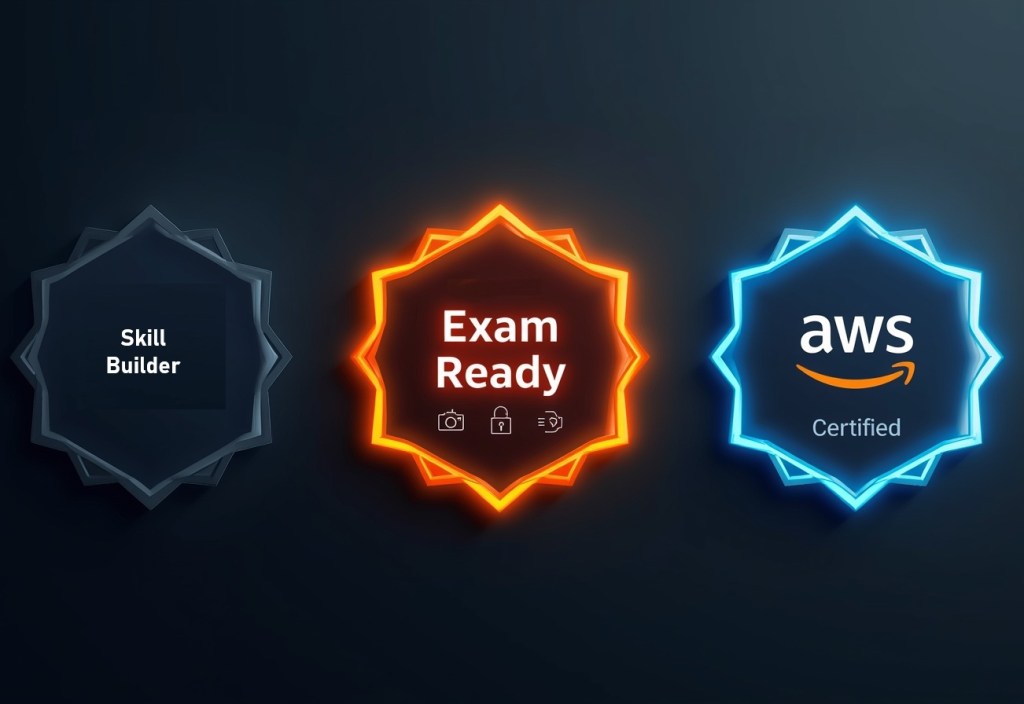
I recently earned the AWS Connect Fundamentals Badge, and while I appreciate what AWS is trying to do with the Skill Builder badge program, there’s a significant opportunity being missed.
As someone in the trenches, the current badge assessments are too easy to game. I don’t mean they should be harder — I mean they should be honest. There’s a difference.
This isn’t just criticism. It’s a proposal for how AWS badges could solve a real business problem: How do we know who’s actually ready for a certification exam?
AWS recently launched microcredentials for Serverless and Agentic AI, which validate hands-on skills in live AWS environments. This is a step in the right direction, but it doesn’t solve the exam readiness gap. Microcredentials aren’t proctored, aren’t positioned as certification preparation, and only cover two niche domains. What’s needed is a comprehensive exam-ready badge program with light proctoring, explicit certification alignment, and organizational adoption in mind.
The Problem: When Assessment Design Undermines Credibility
While I can’t share exact questions due to AWS terms of service, I can describe the pattern: correct answers are 2-3x longer than other options, wrong answers contain obvious negating keywords (“only,” “single”), and anyone with basic test-taking skills can identify the right answer without actual Amazon Connect knowledge.
This pattern undermines value in three ways:
- Practitioners feel undervalued — Why learn deeply when pattern recognition works?
- Organizations can’t trust badges — HR/L&D teams have no confidence these represent capability
- Badge fatigue sets in — Dozens of easy credentials blur together into resume padding
The irony? This undermines the entire AWS training ecosystem AWS has invested in building.
The Organizational Pain Point: The Exam Readiness Gap
Here’s the problem every organization with a training budget faces: How do we know who’s ready to take an AWS certification exam?
This matters because AWS certification exams aren’t cheap:
- Cloud Practitioner: $100
- Associate level: $150
- Professional and Specialty: $300
When someone fails, you’ve wasted $150-300 and damaged their confidence. For organizations managing training budgets for teams of 50, 100, or 500+ people, failed exam attempts add up quickly.
Current Options (And Why They Don’t Work)
Option 1: Already certified (recertification) — Safe, but creates a catch-22 for new certifications.
Option 2: Completed third-party course — Too easy to game. You can watch videos at 2x speed and get a completion certificate without understanding. Completion ≠ competency.
Option 3: Manager judgment — Subjective, inconsistent, and puts managers in uncomfortable positions making technical assessments they may not be qualified to make.
The Gap That Exists
What’s missing is a credible middle signal between “completed some training” and “ready for a $300 3 hour high-stakes exam.”
What’s needed: Free video training → validated exam-ready credential → $300 exam with 85%+ pass rate
Real-World Example
Some exam readiness assessments I’ve seen require:
- Already certified (recertification), OR
- Evidence of third-party training completion
But third-party course completion is too easy to obtain without genuine understanding. This creates two bad outcomes:
- Approval gridlock — managers hesitant to approve vouchers or approve and pray
- Wasted exam attempts — people fail because course completion didn’t mean readiness
There’s no objective, credible measure between “watched videos” and “ready for $300 exam.”
Industry Precedent
AWS isn’t the first to face this. Microsoft offers Practice Assessments, and nursing certification (ANCC) provides $85 Readiness Tests before full certification exams. There’s proven value in a middle tier between free training and expensive, high-stakes certification.

The Solution: A Three-Pillar Exam Readiness Badge Model
Badges can become the bridge between casual learning and certification readiness — not a replacement for certifications, but a credible stepping stone that organizations will actually pay for.
Pillar 1: Proctored Hands-On Labs (Light Automated Proctoring)
The fundamental problem with multiple-choice assessments is that they test recognition, not capability. You can recognize a correct answer without being able to actually DO the thing.
The solution: Task-based assessments that prove hands-on capability.
How It Would Work
Use light automated proctoring inspired by Pearson VUE’s OnVUE system, but less restrictive:
- Camera required — ensures the person taking the test is who they say they are
- Basic application monitoring — detects if someone switches to Google/ChatGPT
- No human proctor needed — makes it cost-effective and scalable
- Time-boxed — 30-45 minute window keeps costs reasonable
This makes cheating difficult without being overly intrusive — the middle ground between “honor system” and “drive to a test center.”
Example: Amazon Connect Exam-Ready Badge
I know an Amazon Connect exam doesn’t exist yet (it really should, in my opinion), but if it did, we could use this assessment as an example. Instead of multiple choice questions, candidates would receive a hands-on challenge:
Task: “Create a Lex bot that handles account balance inquiries with slot validation and error handling. The bot should collect account number and PIN, validate both, and handle cases where validation fails.”
Time limit: 40 minutes
Grading: Automated via AWS APIs
- Does the bot exist in the test environment? ✓
- Does it contain the required intents (AccountBalanceIntent, etc.)? ✓
- Does slot validation work correctly? ✓
- Are error paths properly handled (invalid account, wrong PIN)? ✓
- Does it integrate with a Lambda function for validation? ✓
This is impossible to fake. You either can build it or you can’t.
Why This Works
- Proves capability, not memorization — Can’t game hands-on labs through pattern recognition
- Scales via automation — No human proctors/graders needed; AWS APIs validate infrastructure
- Uses existing infrastructure — AWS already runs workshop environments with ephemeral accounts
- Clearly separates doers from test-takers — Demonstrates actual capability
Start with services that have clear validation points (Connect, Lex, Lambda, S3), then expand to architecture scenarios over time.
Pillar 2: Better Question Design (Not Harder, Just Honest)
For badges that aren’t ready for hands-on labs yet, or for testing conceptual understanding alongside practical skills, we still need multiple-choice assessments. Same proctoring standards (camera, application monitoring), but they need to be designed honestly.
I’m not asking for harder questions. I’m asking for questions that require actual knowledge to answer correctly.
Design Principles That Eliminate Gaming
Principle 1: Similar answer lengths — All answers within 10-15 words of each other. No more “longest answer is correct.”
Principle 2: No obvious negating keywords — Eliminate “only,” “never,” “always,” or “single” unless genuinely part of correct AWS service behavior.
Principle 3: All options must be plausible — Every answer should sound reasonable to non-experts. Differentiation comes from understanding, not “that sounds weird.”
Principle 4: Appropriate difficulty for badge level — Fundamentals badges can ask simple questions; they just need to require actual service knowledge, not test-taking tricks.
This is the pattern AWS already uses in certification exams. Why not in badge assessments?
Example of Honest Question Design
Question: “A financial services company needs resource monitoring for Amazon Connect with strict SLA requirements. Which approach best supports their needs?”
A) CloudWatch dashboards with hourly metric reviews and manual alert configuration
B) Real-time EventBridge rules triggering Lambda for automated threshold responses
C) Weekly CloudWatch reports emailed to operations with summary statistics
D) SNS notifications for critical metrics with 24-hour response procedures
All answers are similar length, sound plausible, and require understanding real-time vs. batch monitoring. The correct answer (B) requires actual service knowledge, not pattern recognition.
The goal isn’t to trick people — it’s to accurately assess whether they know the material.
Pillar 3: Exam Readiness Badges as Organizational Signals
Here’s where badges become something organizations actually pay for: Create a new badge tier explicitly positioned as “Not certified YET, but exam-ready.”
This directly addresses the organizational decision: “Should we approve this $150-300 exam voucher for this employee?”
Tiered Structure
Associate Exam Ready Badges
- Requirements: Complete 3-5 hands-on labs covering key exam domains + pass proctored assessment
- Example: “AWS Solutions Architect Associate – Exam Ready”
- Signals: Prepared for the $150 SAA exam
- Target: 85%+ pass rate when badge holders take actual certification
Professional Exam Ready Badges
- Prerequisites: Associate certification
- Requirements: Advanced multi-service labs + scenario-based assessment
- Example: “AWS Solutions Architect Professional – Exam Ready”
- Signals: Ready for the $300 professional exam
Specialty Exam Ready Badges
- Domain-specific deep dives (Security, Networking, Machine Learning)
- Requirements: Specialized hands-on labs
- Example: “AWS Security Specialty – Exam Ready”
Organizational Value Proposition
For L&D Teams: Clear approval gate • Reduces failed exam waste • Objective readiness signal • Budget predictability
For Employees: Confidence builder • Validates readiness • Clear learning path (Course → Proctored Labs → Proctored Assessments → Exam Ready Badge → Certification) • Resume credential
For AWS: Higher pass rates • Reduced support burden • Market differentiation from Azure/GCP
The Business Model
Current badges: FREE — Serve discovery/marketing function, drive people into AWS ecosystem
Exam Ready badges: Part of Skill Builder subscription or $50-75 standalone — Priced as exam preparation expense, still cheaper than failed exam, more credible than $10-15 Udemy certificates
Community Validation Layer
One more credibility booster: peer endorsement from recognized experts.
Any AWS certified professional could endorse badges, with endorsements weighted by credential level:
- Associate certification: 1x weight
- Professional/Specialty: 2x weight
- AWS Hero / Community Builder / Golden Jacket: 5x weight
When an HR recruiter sees “endorsed by 3 Solutions Architects (Professional) and 1 AWS Community Builder,” they know it’s validated by recognized experts, not just self-directed learning.
The Credly platform already supports this functionality.
Note for Credly: This feedback should also be shared with you, as badge credibility affects your entire platform ecosystem. When AWS badges become more rigorous and valuable, it elevates all badges on your platform.
The Opportunity
All the pieces exist:
Infrastructure: AWS workshop environments, Credly platform, API validation, Pearson VUE proctoring partnership
Demand: Organizations struggle with exam readiness assessment, failed attempts waste significant budget, practitioners want credentials that differentiate capability
Market opportunity: Neither Azure nor GCP has solved this gap. Once organizations integrate exam-ready badges into approval processes, it creates a defensible moat while growing overall certification revenue through higher pass rates.
This is a strategic opportunity, not just a feature improvement.
A Call to Action
To the AWS Community:
What would make badges meaningful to you? Would your organization pay for validated exam-ready credentials? What am I missing?
Continue this conversation:
- Comment below with your thoughts
- Share on LinkedIn: tag @AWS Training & Certification, @AWS Skill Builder
- Post in AWS Forums: Training & Certification Community on re:Post
- Use AWS Skill Builder feedback mechanism
Let’s make AWS badges mean something more than they do.


 Code is Life
Leave a comment